
Many of my clients ask about the Ontario education system, especially how elementary and secondary schools work, the different pathways for students, and how schools are ranked. While I answer my clients’ questions individually, I realized that many would benefit from a general overview. This guide explains how Ontario’s compulsory primary education system works and offers tips for parents—especially newcomers—on navigating this sometimes confusing process.
I know that starting out in a new province or country brings many questions. For example, parents often wonder about how to enrol their children, what paperwork is needed, or how to choose between the various school boards. Understanding these details can help you feel more confident as you make decisions for your child’s education. This overview will cover the provincial education system and also provide insight into the local Ottawa school board landscape, helping you get started on the right foot.
According to the Ministry of Education in Ontario, the education system has 4 main components (Education in Ontario | ontario.ca):
- Early years learning: The focus in these years is to build strong foundations that are central to your child’s learning and growth (0 years old to 3 years old)
- Elementary school: The focus in these years is on developing strong literacy, math, science and social studies skills that build a base for all academic achievement (4 years old (Kindergarten) to 13 years old (Grade 8))
- High school: The focus in these years is to help your child narrow down their interests, support their unique needs for learning and prepare them for graduation and beyond (14 years old to 17 years old (Grade 9 to 12)).
- Postsecondary: A postsecondary education helps your child build a rewarding career after high school (18 years and older, universities (public), colleges (public), career colleges (private) and institutions (private or public))
This article focuses on elementary and high school, since parents often find these topics confusing and ask about them most. It covers mandatory education requirements, school age, school boards, and how to locate your school.
To start, the Ontario’s Education Act mandates all children aged 6 to 18 to attend school (Education Act, R.S.O. 1990, c. E.2 (ontario.ca)), however most kids in Ontario start their education journey at 4 in K1. While your child has to receive education, you do not have to send your kid to the public funded system. Ontario has a wide range of different private schools (Private schools | ontario.ca), and you can also look into homeschooling (Homeschooling | The Ontario Federation of Teaching Parents (ontariohomeschool.org)).
The following graphic from the Ontario Association of School Districts International shows the typical age chart of the mandatory education pathway for Ontario. This is a very easy example of what do expect when you register your child into the Ontario education system for the first time.
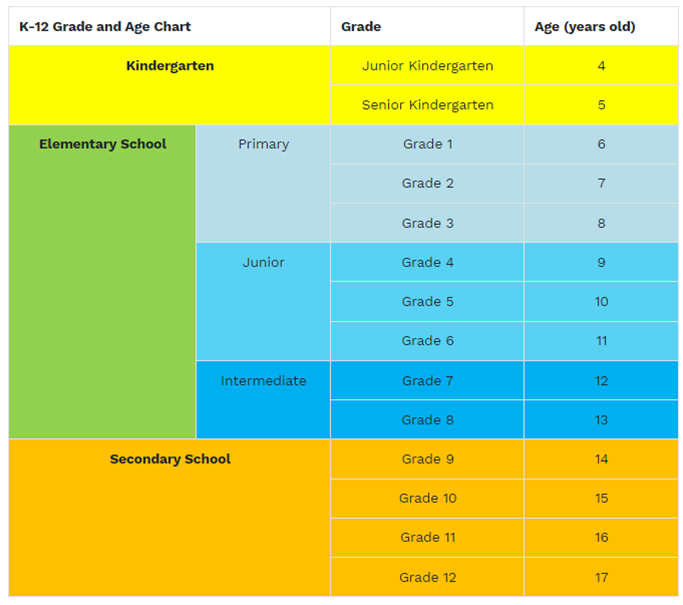
(K-12 Education Infographic | Ontario Education System | OASDI)
While Ontario’s public schools are funded through Ministry of Education and local tax levies, all Ontarian schools are managed by different district school boards. Broadly speaking, the school boards are responsible for student achievement and well-being, safe and inclusive school climates, ensuring effective stewardship of the board’s resources, and delivering effective and appropriate education programs for their students (EN_Good-Governance-Guide-2022-2026_en_aoda_final.pdf). In most of Ontario’s metropolitan areas there are four different school boards:
- English Public & French Public School Boards: Ontario’s English-language and French-language public district school boards provide universally accessible education for all children and students. The public education system is founded on the principle of equality of educational opportunity: every student deserves an opportunity to achieve their full potential. Public school boards provide high standards in their programs and ensure there are supports and resources available to help all students reach those standards. Public school boards are also committed to ensuring diversity, equity and inclusion in program offerings and services. Every student regardless of race, ethnicity, ability or disability, gender, religion, culture and sexual orientation, deserves the right to achieve successful outcomes in school
- English Catholic & French Catholic: English-language Catholic and French-language Catholic district school boards have the same obligations, duties, rights, and privileges under the Education Act as public school boards. In addition, Catholic boards seek to provide a learning experience that allows students to develop their particular skills and individual talents, and to realize their uniqueness as children of God, and as brothers and sisters to every person in the world. The curriculum and activities for both languages catholic school boards are based on components of Catholic faith, and are aimed to o building local Catholic Christian communities.
Currently there are 72 different school boards in Ontario. In Ottawa, the following four school boards manage all the publicly funded elementary & secondary schools:
- Ottawa-Carleton District School Board (OCDSB) is the largest school board in Eastern Ontario serving students within a 2,760 square kilometre area known as the city of Ottawa. The OCDSB has 114 elementary including two special education sites, 25 secondary including Adult High School, and 5 secondary alternate sites (Enrolment Data | Ottawa-Carleton District School Board).
- School locator based on your address: School Locator – Ottawa-Carleton District School Board (ocdsb.ca)
- French Language Public School Board (Le conseil des écoles publiques de l’Est de l’Ontario – CEPEO) serves 44 elementary and secondary schools located between Trenton, Pembroke, Ottawa, Hawkesbury and Cornwall, all in Molière’s language (À propos – CEPEO).
- School Locator: CEPEO (arcgis.com)
- Note to register for French public schools one of the parents needs to have received their primary/secondary education in French in Canada, otherwise a special request needs to be addressed to a selection committee (Élémentaire et secondaire – CEPEO)
- The Ottawa Catholic School Board (OCSB) is recognized internationally for being an innovative faith-based learning community that values equity and wellness. With 89 schools and learning sites throughout Canada’s capital city, OCSB provides quality publicly-funded education to over 45,000 students (Our Schools – The Ottawa Catholic School Board (ocsb.ca)).
- School Locator: BusPlanner Web – BusPlanner Web (ocsb.ca)
- Students of all faiths are welcome
- French Language Catholic School Board (Le conseil scolaire de district catholique de l’Est de l’Ontario – CSDCEO) provides Catholic faith based French education to over 10,500 students in 25 primary schools, 7 secondary schools and adult/child care programs in Eastern Ontario (Conseil scolaire de district catholique de l’Est ontarien – CSDCEO).
- Note that in addition to the French language requirement for parent(s), potential students need to be of Catholic faith in order to register for schools run by the CSDCEO (Conseil scolaire de district catholique de l’Est ontarien – CSDCEO – Formulaires de demande d’admission)
Many clients often ask how one school measures up against another. In Ontario, the absence of a provincial standardized graduation test score for college or university admissions makes this comparison particularly challenging. However, over time, two trusted assessment methods have emerged, providing qualitative and quantitative insights to help determine how a school performs relative to its peers.
- Fraser Institute School Rankings: The Fraser Institute, a think tank, releases annual school rankings based on academic performance using standardized test scores. While some find it helpful, others criticize it for oversimplifying complex educational assessments. You can find more information at Fraser Institute – School Ranking (compareschoolrankings.org) for almost all elementary and secondary schools in Canada. Due to COVID-19 pandemic, most data for Ontario schools is as of 2019. While it is a bit out of date, this is still good as a relative comparison tool.
- Education Quality Accountability Office (EQAO) is an arm’s length government agency that contributes to the quality and accountability of Ontario’s publicly funded education system for K-12. As an evidence-based research-informed organization, EQAO is focused on empowering educators, parents, guardians, stakeholders and the public at large with the insights and information needed to support student learning and improve student outcomes (About EQAO – EQAO). You can find individual school’s assessment here Find My School – EQAO, but you would need a relatively good understanding of what you are looking for in order to understand what the assessment means.
This overview is intended to provide you with essential information about the Ontario education system, focusing on the primary aspects that are most relevant to parents and newcomers. The aim is to clarify some of the key components and processes within the system, which can often feel overwhelming when navigating for the first time.